Overview
Healthcare experiences extend far beyond a mobile application. They are shaped by a combination of digital products, clinical expertise, operational processes, and human interactions working together over time.
While exploring a digital health platform focused on lifestyle coaching, I became fascinated by how seamlessly every touchpoint—from discovery to ongoing engagement—was orchestrated. Rather than studying the interface alone, I decided to reverse engineer the entire service to understand what made the experience effective.
Using service blueprinting, I documented and analyzed the end-to-end experience to uncover the visible and invisible systems that supported the customer journey.
Note: The platform has been anonymized throughout this case study.
The Challenge
Most UX case studies focus on improving screens or interactions. I wanted to step back and understand the broader service ecosystem.
My objective was to answer questions such as:
- How does a healthcare service build trust before users even sign up?
- Which touchpoints influence engagement throughout the journey?
- What operational activities happen behind the scenes?
- How do multiple teams collaborate to deliver a seamless experience?
Instead of evaluating the product, I evaluated the service.
Discovery
I documented every stage of the customer journey, beginning with discovering the service online and continuing through onboarding, coaching, progress tracking, and long-term engagement.
For every interaction, I identified:
- Customer actions
- Frontstage interactions
- Backstage operations
- Supporting processes
- Physical and digital evidence
- Moments of opportunity
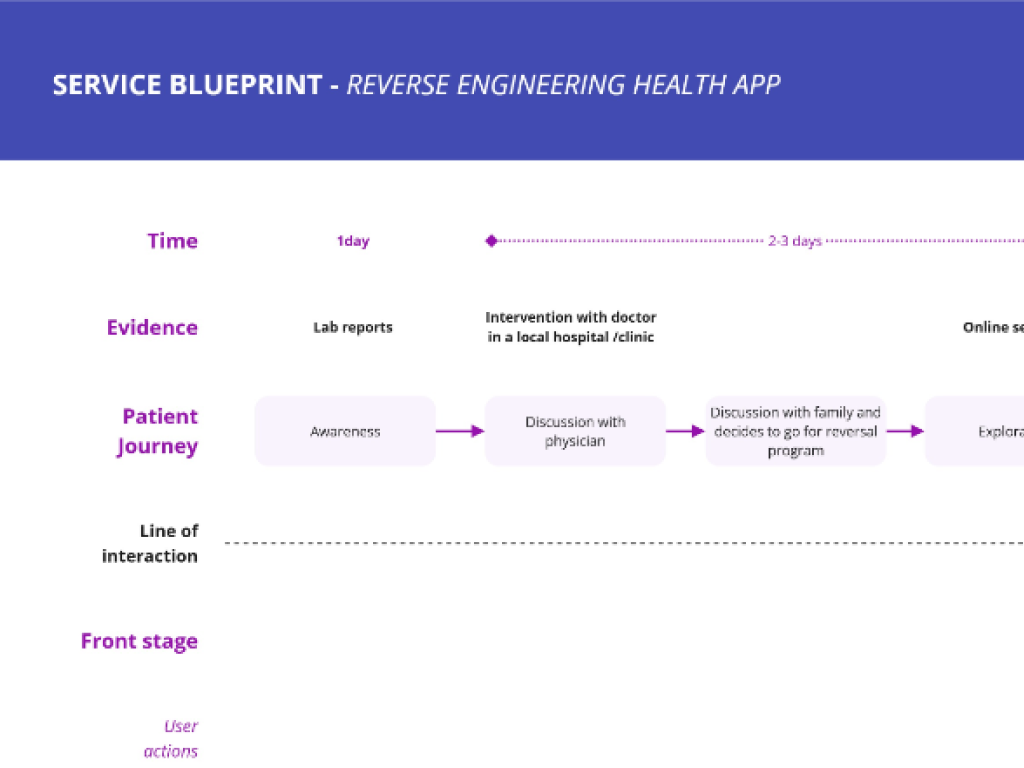
The analysis evolved into a comprehensive service blueprint that visualized how different teams, systems, and touchpoints worked together to deliver a cohesive healthcare experience.
Service Blueprint
(Insert your blueprint image here)
The blueprint maps the experience across multiple layers, including:
- Customer Journey
- Frontstage Activities
- Backstage Activities
- Supporting Processes
- Lines of Interaction and Visibility
- Experience Evidence
By visualizing the entire ecosystem, I was able to understand not only what users experience, but also the operational complexity required to support every interaction.
Key Insights
Great experiences begin long before onboarding
The customer journey starts well before registration. Educational content, discovery channels, and early interactions all contribute to building confidence before users commit to the service.
Behavior change is supported through continuous reinforcement
Rather than relying on a single intervention, the service maintained engagement through timely coaching, regular feedback, progress tracking, and well-timed communication.
Every touchpoint encouraged users to stay committed to their goals.
Operational excellence creates seamless user experiences
Many of the most impactful moments depended on processes users never directly saw.
Clinical teams, health coaches, support staff, logistics, and digital systems worked together behind the scenes to create a unified experience.
The blueprint highlighted how operational design is just as important as interface design.
Outcome
Although this was a personal learning initiative rather than a commercial project, it significantly strengthened my understanding of service design.
The blueprint helped me:
- Understand how complex healthcare services are orchestrated
- Practice documenting multi-layered service ecosystems
- Identify opportunities for improving customer experiences beyond the interface
- Apply service blueprinting as a strategic UX tool for enterprise products
This exercise has since influenced how I approach discovery, journey mapping, and systems thinking in my professional work.
What I Learned
This project changed the way I think about experience design.
Exceptional user experiences are rarely created by interfaces alone—they emerge from thoughtfully designed services where people, technology, and operations work together toward a common goal.
Today, I use service blueprinting not only to understand existing services but also to uncover opportunities for designing more connected and meaningful experiences.